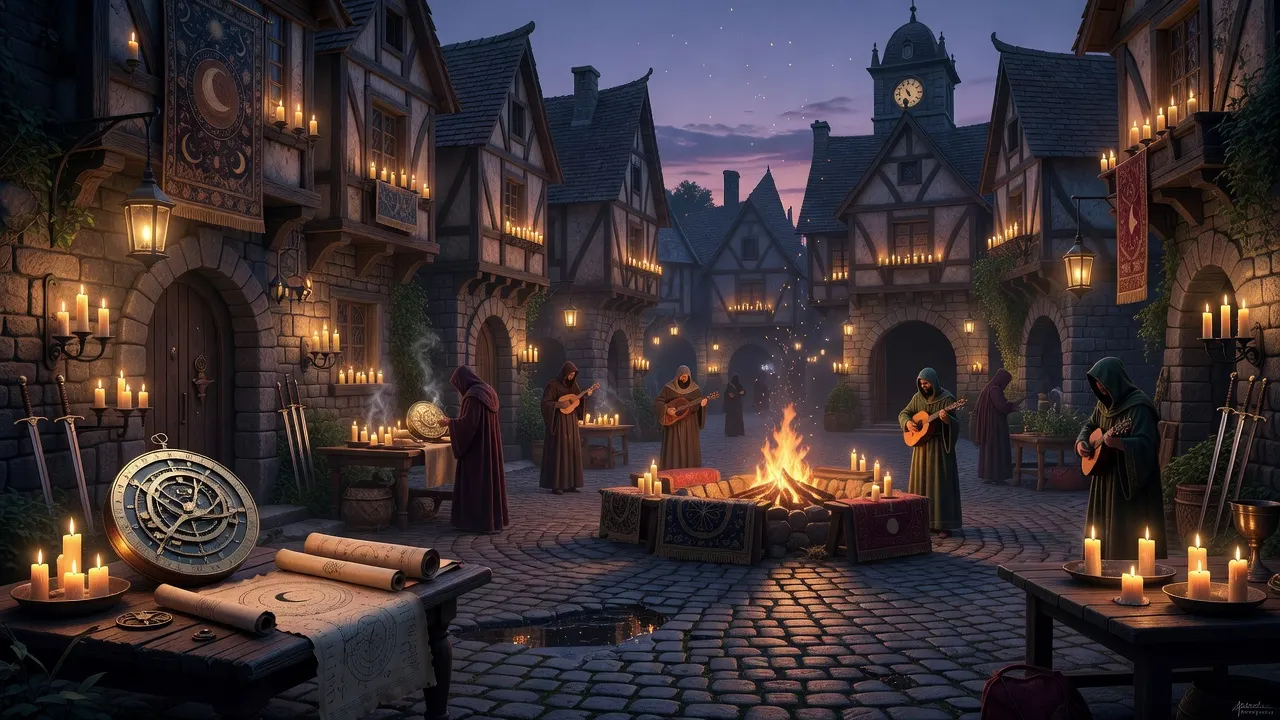
Build a calendar that suits your world, then give its festivals practical consequences. Decide how people mark days, months, seasons and exceptional dates; connect celebrations to work, belief, memory or natural cycles. Use a few recurring events as adventure hooks, and keep the rules consistent enough that readers and players can follow them.
Key facts
- Some calendars organise months around lunar cycles, while lunisolar systems add rules that keep months roughly aligned with the seasons.
- Seasonal festivals can relate to seasonal cycles and food supplies, while harvest celebrations occur at different times in different places because climates and crops vary. Festival Harvest festival
- Fantasy calendars can vary in year length, seasons and divisions, provided the system stays consistent within the story. Fantasy calendar design
- A fantasy calendar can track weekdays, months, seasons, moon cycles, festivals and historical dates. Fantasy calendar maker
Design a time system people can use
Start with the needs of the story or campaign, not with elaborate arithmetic; Choose how the people of your world divide time into days, months and years. Decide whether seasons follow a fixed schedule, natural signs, or a mixture. A calendar should help you place events and help your audience understand when they happen. Fantasy calendar design guidance
Calendars do not need to copy familiar Earth patterns. A setting may use unusual month lengths, seasons or divisions, but the same rules should apply when the story relies on them. If a date matters to a character, give the audience enough context to understand its place in the year.
Consider who keeps time and why. A shared calendar might serve civic life, while a religious or cultural calendar shapes observances. Real-world calendars can affect religious, cultural and civil affairs in different ways, offering a prompt for worldbuilders to consider where a system has influence. Calendar
Make festivals alter ordinary life
A festival feels grounded when it changes what people do, not just what they call a date. Decide whether it interrupts work, draws visitors, changes travel plans or affects access to a public space. A holiday can be a day or period set aside for festivals or recreation, so consider what people gain or give up when it arrives. Holiday
Connect celebrations to pressures that matter in your world. Seasonal festivals may follow the cycle of the seasons and its effect on food supply; harvest festivals can fall at different times in places with different climates and crops. These patterns suggest useful questions: what must be gathered, stored, repaired or shared before the next change?
Let customs reveal disagreement as well as shared identity. One group may treat a day as sacred, while another treats it as a market opportunity or a chance to rest. Festivals can be tied to particular calendar dates, and mythological figures can be associated with parts of the year or celestial events. Building a holiday calendar
Use the calendar to create adventure hooks
Treat the calendar as a schedule of opportunities, not an encyclopaedia of customs. Mark a small number of events that can change what characters can do. Give each one a visible sign, such as a procession, a closed route or a shared meal, then decide what problem interrupts it. Keep the cause and timing clear enough for the group to act. Calendars can help connect festivals, major events and mythological figures to particular dates or periods.
A recurring celebration can carry different stakes from one year to the next. The ceremony stays familiar, but a missing participant, a delayed delivery or a contested interpretation can make its meaning immediate. Tie the hook to a practical consequence of the festival, such as food, clothing, trade, travel, curfews or social permission.
Let local people use time in ways that do not always match a formal calendar. They might refer to a seasonal task, a natural sign or a familiar saying. Decide whether official season dates match lived conditions, or whether people rely on other signs. That gap can provide a clue, a misunderstanding or a source of local knowledge.
Different groups may keep different calendars, but avoid making the difference decorative. Give each system a purpose in the story: a deadline, a dispute over a date, or a festival whose timing matters to a character. A calendar should shape culture and story without making either harder to follow. Time and fantasy worldbuilding
What this means for you?
For a worldbuilder, a working calendar is less about inventing many names than choosing a few rules with consequences. Readers need enough information to follow a journey, a deadline or a seasonal change. Players need dates that help them decide what to do next. Keep the system behind those choices consistent, and reveal details when they matter.
If you are a game master, begin with the next adventure rather than a full historical timeline. Decide which festival, weather shift or public observance will affect the session. Then ask what it changes for the characters: who is available, what routes remain open, what supplies are scarce, or what promises become urgent. Use the answer to shape the situation, not to force a single solution.
Give a festival one central purpose and one complication. A celebration might honour a local story, mark a seasonal task or bring a community together. Its complication could challenge that purpose, such as a missing offering or a dispute over who may take part. The point is not to add spectacle for its own sake; it is to give characters a reason to care about the date.
Use a small number of recurring markers to keep your notes manageable. A named season, a recurring observance and a special day outside the ordinary calendar can each do different work. Share what characters would know, while keeping private deadlines in your preparation notes. A calendar can act as a cultural record as well as a repeating system.
Check every date against the rules you have chosen. If an event depends on a moon, season or harvest, make sure its timing agrees with your world’s system. If the details do not affect a scene, keep them flexible. A clear calendar gives you room to improvise without changing the logic whenever a new hook appears.
What to do now?
- Choose how your year works. Set its length, divisions and seasonal logic only as precisely as your story needs. Keep the rules consistent.
- Name the months or other time divisions that characters will use. Give names a purpose: they should help you signal place, season or custom, not create an extra list to memorise.
- Place four festivals across the year. For each, note who observes it, what ordinary activity changes and what visible sign tells characters it is happening.
- Attach one adventure hook to each festival. Make each hook a choice, clue, deadline or disruption that follows from the event’s role in daily life.
- Add one omen or natural sign that people use to judge the season. Decide whether it agrees with formal dates or creates a gap between official timing and lived conditions.
- Test the calendar against your next scene. Remove any detail that does not help establish timing, culture or a choice for the characters.
Sources
- en.wikipedia.org/wiki/Festival
- en.wikipedia.org/wiki/Harvest_festival
- www.summonworlds.com/fantasy-calendar-time-design
- www.summonworlds.com/resources/fantasy-calendar-maker
- behindthedraft.com/set-up-a-fantasy-calendar
- en.wikipedia.org/wiki/Calendar
- en.wikipedia.org/wiki/Holiday
About this page
Written with AI assistance from the sources listed above, then checked by automated fact, source, repetition and quality checks before publishing.
Facts and links checked on 1 November 2026. Summarises the sources linked above; check the linked source for the latest version.
How we researched this: we compiled this guide from the official and independent sources listed above, and checked the facts on the date shown. Our editorial policy explains how we choose and check sources.