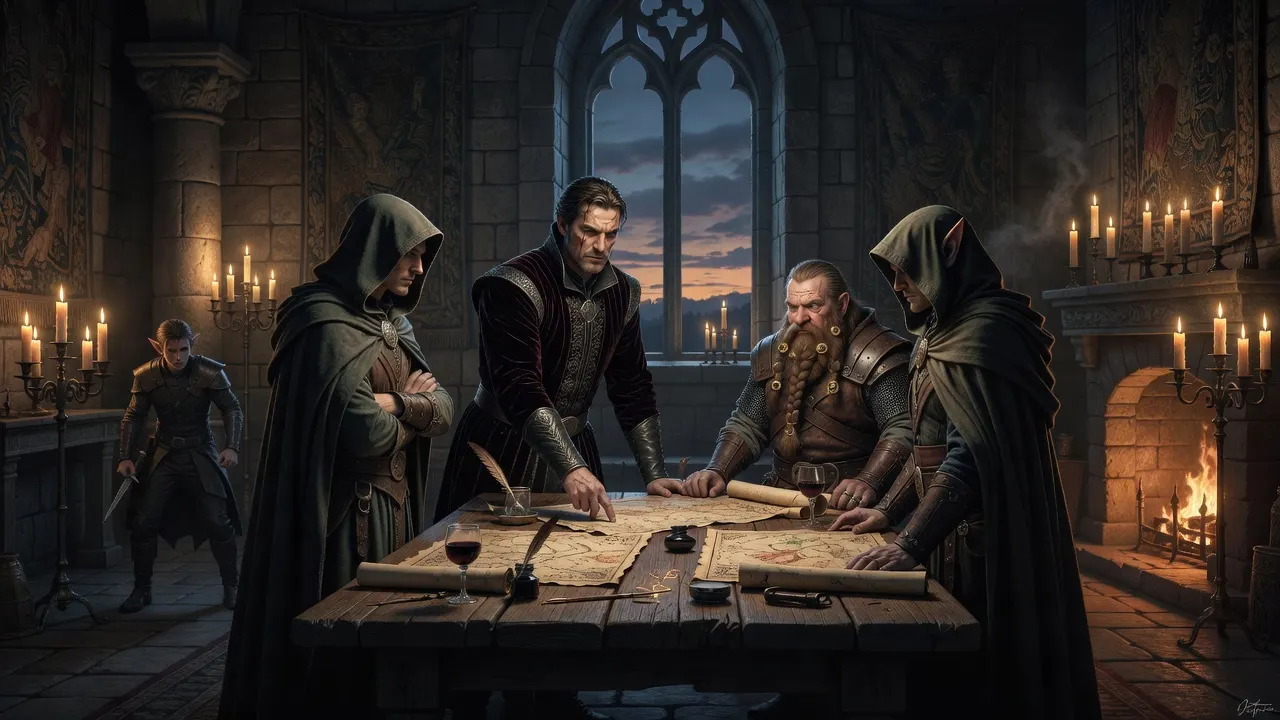
Keep political intrigue legible: give players a clear arena, a few factions with distinct aims, and stakes they can understand. Offer more than one route towards a goal, and let player choices change what happens. Make information usable at the table with brief recaps and visible relationships. Ask what kind of intrigue players want before building it.
Key facts
- A faction is a group with a shared political purpose; factions within a party can hold different interests or opinions.
- Political play asks players to set goals, spot obstacles and devise solutions with limited GM guidance.
- Intrigue can become hard to follow when players cannot keep track of complex information.
- A campaign can offer clear surface-level stakes while keeping the underlying situation messy.
Keep the political arena small and clear
Begin with the decision that matters now; it might concern a law, a succession, a public resource or a promise. State what could change, who cares about that change, and what the characters can do about it. A clear goal gives players somewhere to direct questions and plans.
Build only the groups needed to make that decision contested; each faction should have a shared purpose and a reason to disagree with at least one other group. A faction is defined by common political purpose, while people within one party can hold different interests. Turn that distinction into play: give each group a want, a boundary, and something it can offer or withhold.
Do not make size stand in for depth. A campaign guide argues that intrigue does not need ten houses, thirty characters or a conspiracy players must memorise. Instead, make a small number of relationships matter. If a new faction adds no choice, pressure or useful information, leave it out for now.
Put the characters inside the arena through a stake they can name. That stake might be a person they want to protect, a decision they hope to influence, or a promise they need kept. Political campaigns work better when characters have stakes beyond the quest giver’s request. Ask players to choose what they care about, then connect that interest to the current decision.
Give players information they can act on
Intrigue needs secrets, but players also need a readable surface. Tell them what is at risk before hiding who caused the problem or what each faction intends. A political campaign works when players understand the arena, care about the stakes and can change the balance of power through their choices.
Make every clue useful in a decision. A rumour might reveal a rival’s constraint; a meeting might expose a possible bargain; a public demand might force the characters to choose whom to support. Avoid information that only decorates the setting. Political play centres on gathering intelligence, building alliances and outmanoeuvring rivals through strategy. Give players enough knowledge to try a specific action, rather than requiring them to solve an unseen web first.
Offer several routes towards an outcome. One group might persuade a rival, another might trade a favour, and another might reveal evidence. Do not decide in advance which route must work. A campaign can frustrate players when it pushes them towards predetermined outcomes. Prepare people, aims, pressures and consequences, then let the characters’ methods determine which possibilities become real.
Protect trust while making choices matter
Political tension should create pressure between characters and the world, not turn the players against one another by default. One campaign guide warns against allowing players to backstab each other freely. Agree what kinds of conflict the group wants, and make betrayal an opt-in possibility rather than an assumption.
Give rivals room to negotiate. A faction that refuses every possible bargain is a wall, not a political actor. Let an opponent have a goal, a limit and a price for changing course. That makes negotiation a real choice, even when the characters cannot get everything they want.
Keep consequences visible. If the characters help one group, show what that group can now do, and what the choice costs elsewhere. Political campaigns gain weight as player decisions accumulate over time. A changed alliance, a lost opportunity or a new obligation can make progress feel tangible without requiring every scene to end in a fight.
Remember that the GM provides the setting and supporting characters while players lead the action. Treat a failed plan as a reason to change the situation, not as a reason to close every door. Keep the next decision visible, and leave room for players to approach it in their own way.
What this means for you?
Political intrigue does not need to be a puzzle with one hidden solution. It works better when players can see the decision in front of them, understand why it matters, and choose how to engage. You can preserve mystery around motives and methods without hiding the basic stakes.
If you are a GM preparing a council dispute, start with one outcome the characters can influence. Choose a few groups that want different results. Give each a reason to deal with the characters, and a limit that makes its position believable. Then decide what information the players can learn before they commit. This is enough structure to support surprises without requiring a vast private history.
Make the players’ own priorities part of the political situation. A character’s loyalty, reputation, safety or promise can connect a public dispute to a personal choice. Do not force that connection; ask what the player wants their character to protect or change. The answer helps you shape pressure that feels relevant rather than arbitrary.
During play, keep a simple record of who wants what, what has changed, and what remains undecided. Show the players the parts they need to plan. When they act, describe the immediate result and any new pressure that follows. If they take an unexpected route, follow the logic of the people and interests you established instead of steering them back to a prepared sequence.
After a session, note which clues prompted action and which created confusion. Clarify the latter in the next scene, or remove them. Your aim is not to make every player remember every name. It is to make sure they can choose a useful next step and see why that choice matters.
What to do now?
- Choose the decision. Write one sentence stating what might change and what the characters can influence.
- Define three factions. For each, record its shared aim, its boundary, and one thing it can offer or withhold. Keep the list short enough to use during play.
- Connect the conflict to the characters. Give each player a chance to name a person, promise or principle their character wants to protect. Link those stakes to the decision without dictating the character’s response.
- Draw a relationship map. Mark who supports, opposes or needs whom. Add only relationships that could affect a choice. Use the map as a prompt, not a script.
- Prepare usable use. Give the characters clues, favours or bargaining points that open more than one approach. Make sure rivals can respond to a plausible offer.
- Recap and update. Open the next session by naming the live decision and the characters’ options. After play, record what changed, then remove details that no longer matter.
Sources
- en.wikipedia.org/wiki/Political_faction
- crithitceramics.com/dd-political-campaign-dm
- thedmlair.com/blogs/news/how-to-run-a-political-intrigue-campaign-in-d-d
- www.sessionroll.com/blog/political-intrigue-campaign
- koboldrest.com/political-intrigue-ttrpg-session-no-combat
- en.wikipedia.org/wiki/Game_master
About this page
Written with AI assistance from the sources listed above, then checked by automated fact, source, repetition and quality checks before publishing.
Facts and links checked on 1 November 2026. Summarises the sources linked above; check the linked source for the latest version.
How we researched this: we compiled this guide from the official and independent sources listed above, and checked the facts on the date shown. Our editorial policy explains how we choose and check sources.