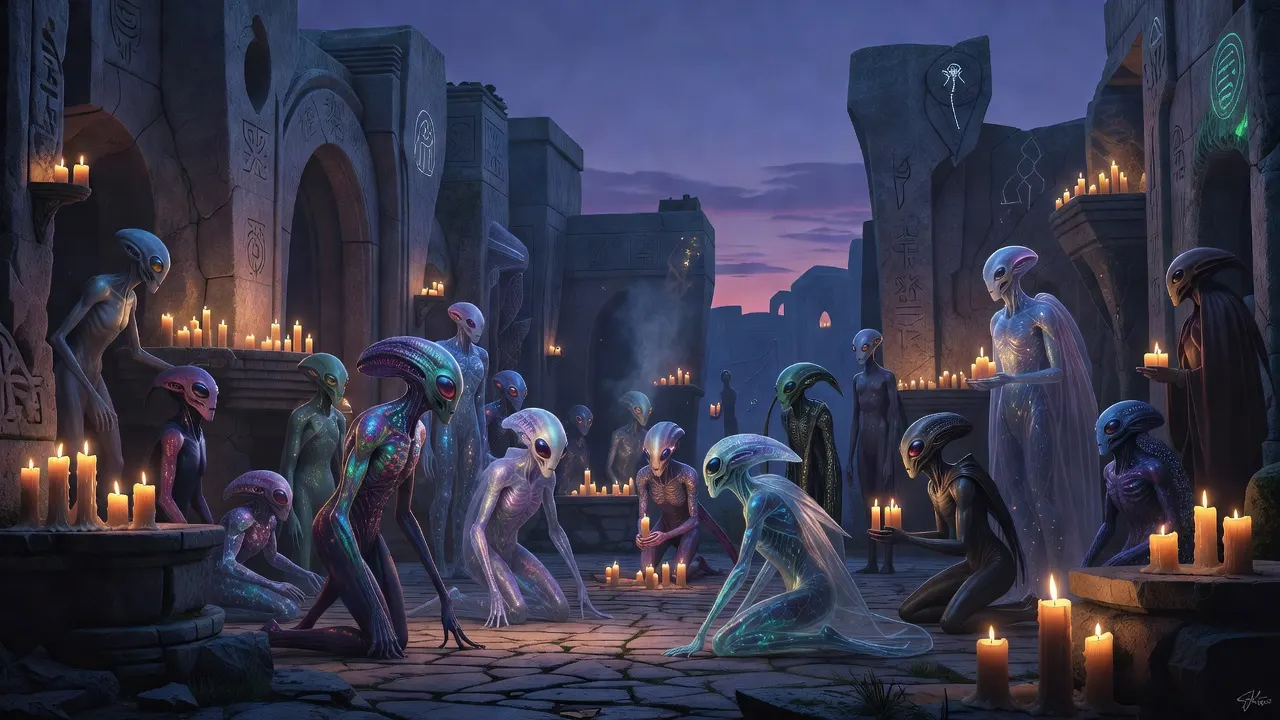
Build an alien culture from the conditions that shape its members, not from a human society with unfamiliar costumes. Decide how biology and environment affect perception, needs and social life. Then work through language, values, customs and disagreement. Make each cultural detail serve a reason, while leaving room for individuals who do not fit the pattern.
Key facts
- Fictional extraterrestrial intelligence may be less capable than humans, comparable, far beyond them, or impossible to compare. [F1]
- Worldbuilding can include constructed species, cultures and languages, and making an alien culture cohesive can be challenging. [F21, F22]
- Biology can shape the psychology and social structures of alien characters. [F39]
- Naturalistic fictional languages may use irregular forms and complex sound patterns, rather than prioritising easy communication. [F8, F10]
Start with the conditions that shape a species
A familiar social order becomes an alien culture only when its customs have causes beyond costume. Begin with the body: what does this species sense, need, and struggle to do? Then ask how those traits affect attention, emotion and cooperation. Writers are advised to ground alien cultures in biology rather than appearance or politics. [F28] [F39]
Next, consider the surroundings that press on daily life. A species’ environment can inform the problems its members solve together, the habits they value and the tools they develop. Treat these as design choices, not as a claim that one environment dictates a single society. Worldbuilding can shape lifeforms around environmental adaptations to scientifically novel situations. [F24]
Link each detail to a consequence. If a sense is central to perception, decide how that affects greeting, privacy or art. If a physical need affects gathering, decide how groups organise shared duties. This is a reasoning framework, not a formula: give yourself alternatives, then choose details that fit the story you want to tell.
Biological differences need not erase emotional points of contact. Build characters whose bodies and assumptions differ, then give them stakes a reader can understand through their choices. One writing guide frames this balance as logical biological and cultural foundations alongside universal emotional experiences. [F36]
Make language and customs reveal different assumptions
Language is more than a list of invented words. Decide what its speakers need to distinguish, how they signal uncertainty, and what meanings remain hard to translate. These decisions can influence negotiation, humour and misread intentions. A constructed language can be made for fiction, and naturalistic fictional languages may mimic patterns such as irregular nouns and verbs. [F7, F8]
You do not need to create a complete language to make communication feel unfamiliar. Choose a few meaningful features and show their effect in use. Perhaps characters disagree because one speaker expects a message to encode evidence, while another expects it to express a relationship. Keep the example tied to your invented species; it is a prompt, not a universal rule.
Make customs follow from the culture’s circumstances, rather than borrowing a recognisable ceremony and changing its name. Ask what a ritual helps people remember, coordinate or express. A culture’s artistic forms can add texture, and fictional alien societies may have their own rituals and arts. [F48, F49]
Do not make every member share one view. Give the society internal disagreement: characters may interpret the same value differently, or argue over what a custom should mean. A culture with internal diversity can feel more vivid and avoid reducing a complex world to one trait. [F55]
Build difference without losing character
Use human comparison as a tool for the reader, not as the blueprint for the alien society. An analogy can help explain one feature, but relying on Earth-based analogies or stereotypes risks making the culture familiar in the wrong way. [F46] Let each comparison expose its limits: where does the analogy stop working, and what does the alien perspective make visible?
Separate species-wide constraints from cultural choices. A bodily capacity may shape what is possible, but the society still needs choices, values and customs that characters can interpret differently. This distinction lets you avoid treating every member as interchangeable. It also helps you test whether a cultural detail follows from your design or merely repeats a human social template.
Choose a few differences with narrative consequences instead of multiplying odd features. A slow or fast thought process, for example, can change what counts as a patient exchange or a timely decision. Speculation about alien thought includes processes much slower or faster than human thought. [F16] Treat that possibility as a story premise and explore its effects; do not present it as a settled fact about aliens.
Finally, let cultural design generate scenes. A character’s belief should affect what they do, what they refuse and what they misunderstand. Keep the creator’s notes flexible: when a new scene reveals a contradiction, revise the culture rather than forcing every character to obey a tidy rule. Cohesion matters, but so does room for change and conflict.
What this means for you?
For a writer or game master, this method turns alien culture into a practical story engine. Instead of asking only what the inhabitants wear, ask what their bodies and surroundings make easy, difficult or important. Write down a cause, then follow it into a custom, a disagreement and a scene. Keep the links clear enough that you can explain them to yourself, but subtle enough that the reader or players discover them through action.
If you are a game master preparing a first meeting between human explorers and an alien community, give each side a different assumption about what counts as a respectful exchange. The alien behaviour should have a reason within your design, not exist merely to confuse the party. Let the human characters make a plausible mistake, then give them a chance to learn. That creates tension without making the alien characters into a puzzle or a threat by default.
What to do now?
- Choose senses. Decide what your species notices first and what it might miss. Connect that choice to one everyday interaction, such as recognising another person or sharing information.
- Define the environment. Pick the conditions your story needs, then note one problem they create for daily life. Use that problem to shape a practical habit, rather than treating the environment as decoration.
- Set a social unit. Decide which relationships or groups matter most to your characters. Explain what need or value makes that arrangement useful within the culture.
- Name a misread value. Choose one principle that human visitors could interpret wrongly. Show what the alien characters mean by it through an action, not just an explanation.
- Create two factions. Give them different interpretations of one shared custom or value. Let both positions make sense from within the society, and use their disagreement to create a scene.
- Check the links. Trace each major custom back to a cause, then ask whether characters can disagree about it. Remove details that only imitate a familiar human template.
Sources
- en.wikipedia.org/wiki/Extraterrestrials_in_fiction
- en.wikipedia.org/wiki/Worldbuilding
- proseengine.app/blog/writing-alien-cultures-and-non-human-characters
- en.wikipedia.org/wiki/Constructed_language
- proseengine.app/blog/how-to-write-alien-cultures-that-feel-authentic
- behindthedraft.com/writing-an-alien-culture
- bmallane.com/inventing-cultures-without-reinventing-earths-history-a-guide-for-fantasy-sci-fi-writers
- en.wikipedia.org/wiki/Fermi_paradox
About this page
Written with AI assistance from the sources listed above, then checked by automated fact, source, repetition and quality checks before publishing.
Facts and links checked on 31 October 2026. Summarises the sources linked above; check the linked source for the latest version.
How we researched this: we compiled this guide from the official and independent sources listed above, and checked the facts on the date shown. Our editorial policy explains how we choose and check sources.