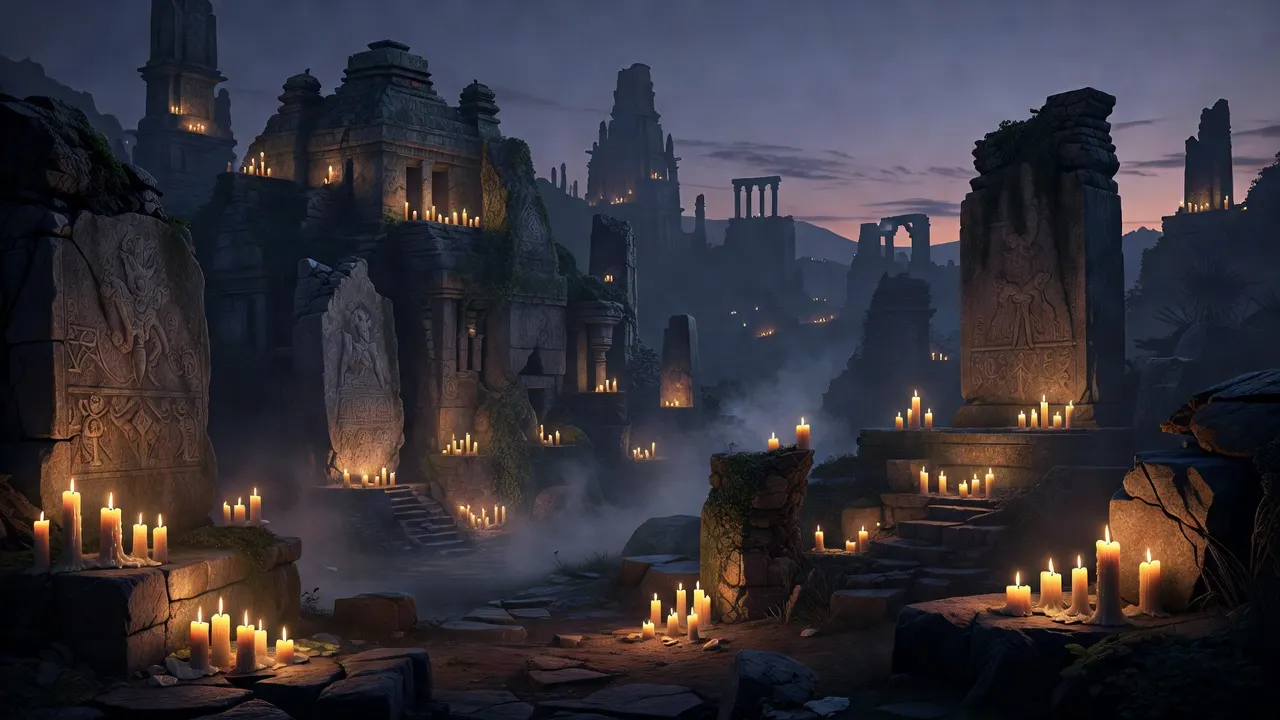
Build a lost civilisation from the lives it supported, the pressures that ended it and the traces that remain. Give its ruins distinct layers, uses and signs of later change. Then connect those traces to people in the present, so exploration reveals a history with consequences rather than a decorative backdrop.
Key facts
- Lost cities can be forgotten entirely or remembered in stories and records while their locations are lost.
- Ruins can come from buildings with many different uses, from fortifications and houses to whole settlements.
- Archaeological interpretation groups individual contexts by their relationships to one another.
- Treasure-seeking can damage archaeological sites.
Give the civilisation a life before its fall
Start with ordinary needs, not a monument. Decide what people built to obtain water, move goods, gather, worship, govern or rest. Those needs give the city a practical shape: routes link places, buildings serve repeated tasks, and public spaces make shared life visible.
Next, choose how knowledge of the place survived. A lost city may slip from memory altogether, or remain in myth, legend or written records after its location becomes unknown. That choice shapes what people believe before the party arrives. A remembered place invites arguments over stories and directions; a wholly forgotten one makes recognition itself part of discovery. Keep surviving accounts partial, so characters have reasons to compare them with physical evidence.
Give the civilisation a strength that also creates a vulnerability. A society might depend on one trade route, a fragile water system, a political alliance or a scarce resource. This is a design prompt, not a claim that every real civilisation fell for one cause. The ending can combine pressures, and some communities can outlast the wider upheaval. Historical records describe that a small number of powerful states survived a period of widespread collapse. Make the cause legible through consequences, not a lecture: blocked channels, altered routes or repairs that stop abruptly.
Do not let the fall erase every trace. A forgotten civilisation can remain relevant to the living world, and its legacy can hold triumphs, mistakes, mysteries and legends. Decide who still uses its roads, fears its stories, claims its land or seeks its objects. These ties turn ancient history into present pressure and give characters a reason to care beyond curiosity.
Make the ruins show change over time
Design the site as a sequence rather than a single frozen scene. Archaeological reasoning groups individual contexts through their relationships, and the relationship between layers helps interpret a site. In play, a sealed room beneath a later floor, or a wall reused as a foundation, can reveal that the place changed hands or purpose. Leave enough physical clues for players to form and test theories.
Ask what survives, what decays and what later inhabitants alter. Ruins can represent houses, places of worship, fortifications, utility buildings or entire settlements. Let each surviving feature answer a different question: a repaired gate suggests continued use, while a blocked entrance hints at a later choice. Avoid making every structure equally intact. A varied site gives players things to compare and prevents exploration from feeling like a tour of matching rooms.
Later occupants make the site less like a museum and more like contested ground. Rulers have rebuilt cities by overlapping earlier ruins or building beside them. Borrow that pattern for fictional history: one group might turn a civic hall into a storehouse, while another builds a shrine beside it. Such changes let players distinguish the civilisation that began the site from those who inherited it. They also create practical conflicts over access, ownership and sacred space.
Give discovery a cost as well as a reward. Interest in ancient objects can lead treasure-seekers to damage archaeological sites. In a campaign, characters might meet rivals who prize portable relics over careful investigation, or find that a useful clue could be destroyed by careless entry. Let preservation matter to someone in the present: a local community, a scholar or a custodian. This creates choices about what to remove, record, protect or leave undisturbed.
What this means for you?
A ruin becomes useful at the table when every feature can prompt a choice. A collapsed bridge is not only scenery if the party must decide whether to cross, search below or find a safer route. This carved panel gains purpose when it can challenge a story the characters already heard. Use the physical site to offer evidence, obstacles and decisions together.
If you are a game master, prepare a small set of clues instead of a complete account of the civilisation. Give each clue a clear source: a building’s arrangement, an object’s wear, a later repair or a local story. Players can compare those sources and disagree about what they mean. Archaeological interpretation depends on relationships among contexts, which offers a useful model for how separate discoveries can build a larger picture.
Make uncertainty fair. The party may not know whether a city was forgotten outright or survived in legend after its location disappeared, because both patterns exist in accounts of lost cities. Let evidence narrow possibilities without forcing one instant answer. A mistaken theory can still lead to a worthwhile action if the players have a reason to test it.
Connect the past to people who can be affected now. A relic might matter less for its power than for the argument over who may keep it. A buried structure might threaten a present route or shelter. Lost civilisations can give a campaign mystery and scale, but they work best when their presence does more than decorate the map. Put the living consequences within reach of the players, then let their decisions change who benefits from discovery.
Keep the history open enough to support play. You do not need to decide every date, ruler or cause before the first visit. Instead, know what each clue can establish, what remains disputed and which present-day person has a stake in the answer. That gives you room to respond to player theories without making the past arbitrary.
What to do now?
- Choose what the civilisation built and what daily need each structure served. Use those uses to shape routes, gathering places and private spaces. Ruins can preserve traces of many kinds of buildings and settlement.
- Decide why the civilisation fell, then show the result in a damaged system, altered route or reused building. Keep the cause clear enough to investigate, but do not make every clue agree at once.
- List what survived and what later occupants changed. Arrange the traces so players can compare their relationships, rather than presenting every feature as part of one moment.
- Name who seeks the site now and what they want from it. Include someone who values its history, since treasure-seeking can damage archaeological remains.
- Write one unanswered question that connects the ruin to the living world. Make its answer matter to a person, place or choice the party can encounter.
Sources
- en.wikipedia.org/wiki/Lost_city
- en.wikipedia.org/wiki/Ruins
- en.wikipedia.org/wiki/Stratigraphy_(archaeology)
- en.wikipedia.org/wiki/Archaeology
- saraswritingsanctuary.com/2026/07/03/how-to-create-forgotten-civilizations-for-your-fantasy-world
- en.wikipedia.org/wiki/Bronze_Age_collapse
- saraswritingsanctuary.com/2026/07/09/how-to-create-forgotten-civilizations-breathing-life-into-the-lost-worlds-of-fantasy
- litrpgreads.com/blog/rpg/exploring-forgotten-kingdoms-campaign-ideas-around-lost-civilizations
About this page
Written with AI assistance from the sources listed above, then checked by automated fact, source, repetition and quality checks before publishing.
Facts and links checked on 1 November 2026. Summarises the sources linked above; check the linked source for the latest version.
How we researched this: we compiled this guide from the official and independent sources listed above, and checked the facts on the date shown. Our editorial policy explains how we choose and check sources.