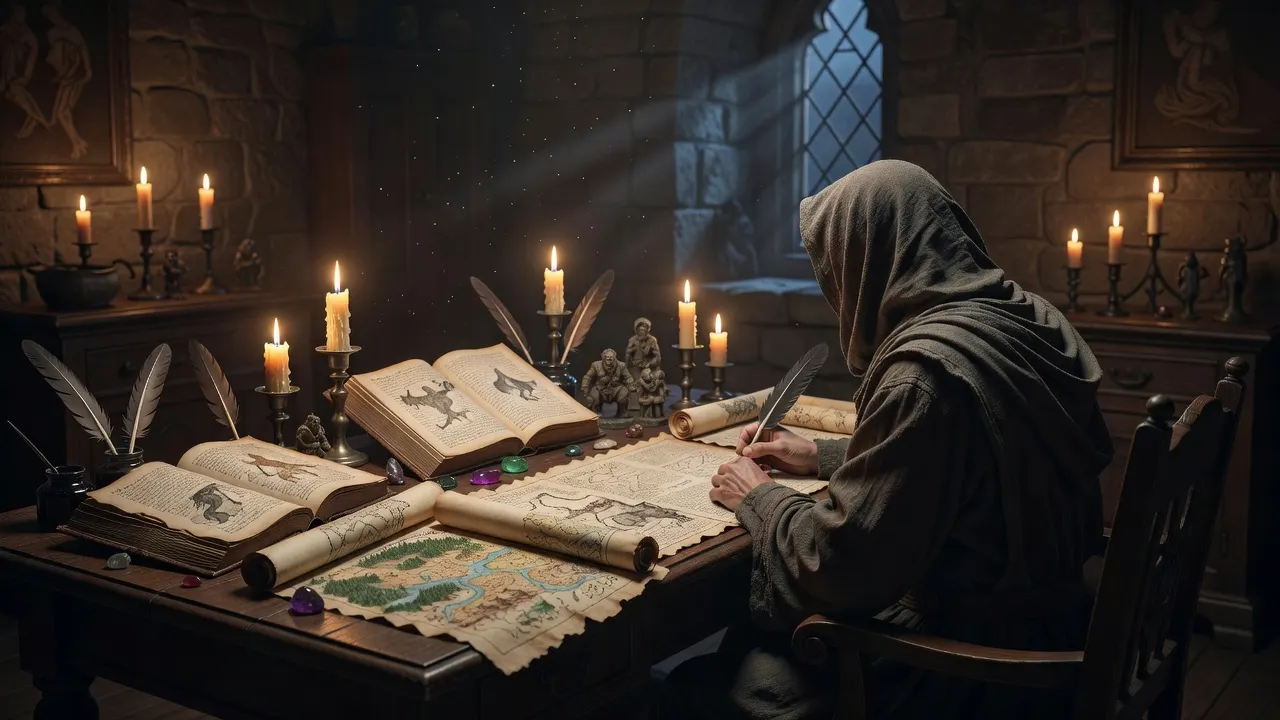
Start with the story or play experience you want your setting to support, then build only the lore that helps deliver it. Choose a broad fantasy approach, sketch the places and forces that matter, and add people, history and magic where they create useful choices.
Key facts
- A story-first process can guide fantasy worldbuilding, rather than requiring you to create everything at once.
- Guided questions and creative prompts can help you make deliberate choices based on the story and reader experience you want.
- A fantasy novel’s premise, characters, theme, basic worldbuilding and magic system can all inform one another.
- Fantasy settings can serve fiction, tabletop role-playing games and video games.
Start with the experience your world should create
Before naming kingdoms or drawing borders, decide what your setting is for. A novel, a game campaign and a video game can all use fantasy lore, but each gives people a different way to encounter it. Write one plain sentence about the experience you want: a tense journey, a cosy refuge, a political struggle, or a mystery. Treat that sentence as a working guide, not a rulebook.
For a story, begin with the premise and the setting that will carry it. Ask what problem could only happen in this world, and what makes its solution difficult. For a game, ask what players can explore, choose or change. These are planning prompts, not facts you need to settle permanently. Their purpose is to give each piece of lore a job.
Then choose a broad approach. One guide distinguishes between real-world fantasy and second-world fantasy. Use that distinction to consider how closely your setting relates to the familiar world. You do not need to settle every detail now. Pick the approach that best supports the experience you described, and leave room to adjust it as the premise develops.
Keep the scope deliberately modest. A newcomer-focused resource reports that worldbuilding advice often tells beginners to start smaller than they think they need to. For your first pass, define a single trouble spot, community or journey. You can widen the setting later, once the immediate story or play experience gives you a reason.
Build connected lore in layers
Start with the physical frame: the place where the first important action happens, and the conditions that shape it. A worldbuilding guide recommends giving the world a physical shape after establishing a premise and foundation. Sketch only what affects movement, resources, danger or daily life. If a landscape feature does not change a choice, it can wait.
Next, add people and power. Decide who lives in the starting area, what they need, and what groups disagree about. Characters are part of the broader process of writing fantasy, alongside premise, theme, worldbuilding and plot. Give each invented custom or institution a consequence for someone in the story. This keeps lore tied to action instead of becoming a detached catalogue.
Use prompts to test and refine the setting
Turn each layer into questions that demand a choice. A step-by-step worldbuilding resource describes guided questions and creative prompts as tools for deliberate decisions about a story and its intended reader experience. Ask what a traveller notices first, who benefits from a local rule, or what a character risks by using magic. Answer only the questions that make the setting more playable or more vivid.
Test details in a scene or game situation. A fantasy-writing guide recommends sensory details and creative comparisons as ways to make a world immersive. Do not add description simply to decorate a page. Choose details that show how a place feels, what a character notices, or why the setting affects the next decision. If the lore cannot change what someone sees, knows or does, it may not need space yet.
Keep a compact lore record. Use separate notes for places, people, rules and past events, with a line explaining how each detail connects to the central premise. Mark uncertain ideas as provisional. This makes it easier to distinguish a settled rule from an option you are still exploring, and to avoid treating every early thought as permanent canon.
Revise by looking for contradictions and empty links. If a rule says magic is costly, but a character uses it without consequence, either change the rule or show why this case differs. If a past event is important, let its effects appear in present choices. This is a practical editing method, not a claim that every setting needs the same history, magic or structure.
What this means for you?
You do not need a complete atlas, royal family tree or creation myth before you begin. You need a useful starting area and enough connected lore to make its conflicts understandable. The difference is practical: a broad inventory collects information, while a working setting gives characters or players reasons to act.
If you are a game master preparing a first session, sketch the settlement where play begins, one nearby place worth visiting, and one problem that affects both. Then note who wants what, what blocks them, and which detail players can change. Leave distant kingdoms and ancient eras as questions unless the opening situation depends on them. Your players can reveal which unanswered details deserve attention.
If you are writing fiction, make the same test with a scene. Give the viewpoint character a goal, then decide which rule, custom, place or magical limit makes that goal harder. Add one or two details that let the reader sense the environment. Keep the rest out of the scene until a character needs it. This gives exposition a purpose: the reader learns lore while following a choice.
When an idea feels exciting but does not yet affect the premise, save it in a parking list. You are not rejecting it; you are preventing it from taking over the work. Return to that list when the story or play raises a related problem. This method protects creative freedom while keeping the first version manageable.
Think of each note as a tool rather than a promise. You can change a custom, move a boundary or rethink a magical limit when testing exposes a better option. Keep changes consistent with the choices already made, and update any linked notes. The aim is not perfect completeness. It is a setting clear enough to support the next scene, session or design decision.
What to do now?
- Write one sentence describing the story or play experience you want. Use it to judge whether each new lore idea helps.
- Choose a broad fantasy approach and a small starting area. Make a rough sketch of the location, without filling in distant regions.
- Define one immediate conflict. Note who wants what, what stands in the way, and what could change if someone acts.
- Set only the rules for magic, customs or history that affect that conflict. Leave other questions open rather than forcing an answer.
- Test the notes in a scene or game situation. Add sensory details where they help someone understand the place or make a choice.
- Revise anything that contradicts the premise or has no effect. Keep useful unanswered ideas in a separate list for later.
Sources
- www.quillandsteel.com/blogs/writing-tips/fantasy-worldbuilding-guide
- stepbystepworldbuilding.com
- www.quillandsteel.com/blogs/writing-tips/how-to-write-fantasy
- www.anima-roleplay.com/resources/worldbuilding/worldbuilding-fundamentals
About this page
Written with AI assistance from the sources listed above, then checked by automated fact, source, repetition and quality checks before publishing.
Facts and links checked on 1 November 2026. Summarises the sources linked above; check the linked source for the latest version.
How we researched this: we compiled this guide from the official and independent sources listed above, and checked the facts on the date shown. Our editorial policy explains how we choose and check sources.