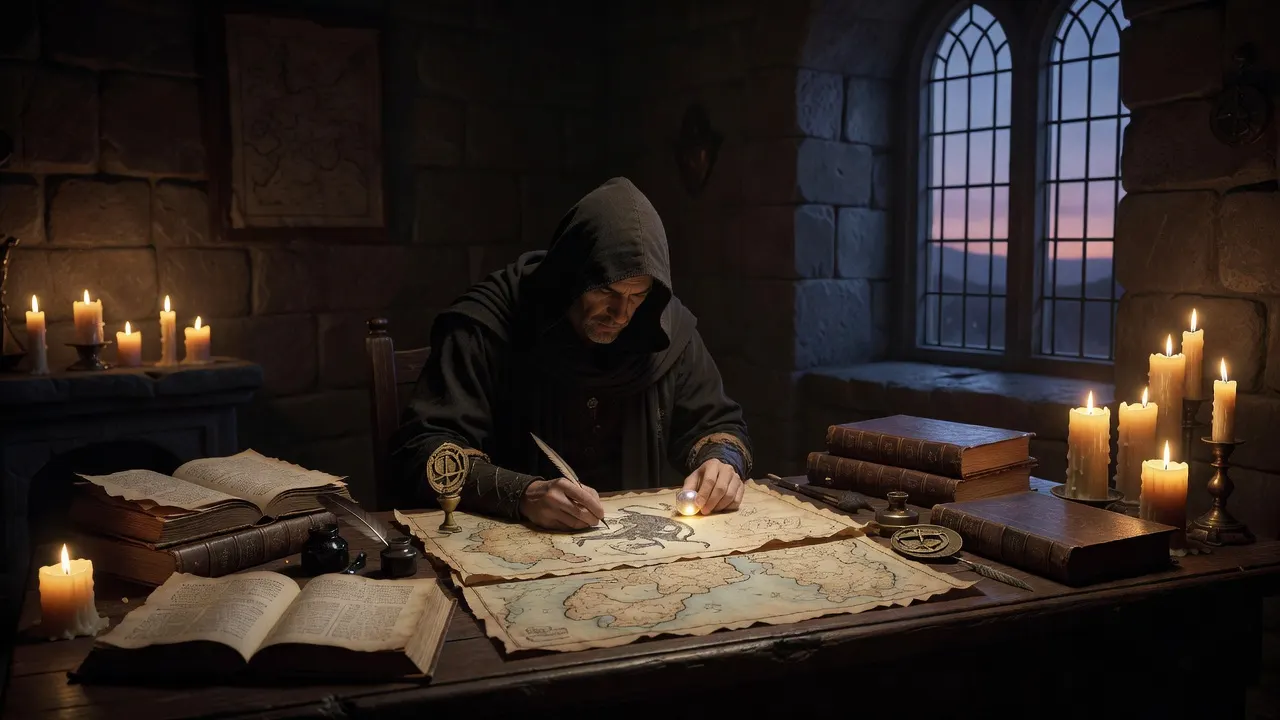
Build lore as a living inheritance: connect past events to present pressures, then let characters encounter the consequences through choices, places, beliefs and magic. Reveal only details that strengthen emotion, plot or character. Expand history when a story needs it, keep distant eras broad, and make every invented system interact with the world around it.
Key facts
- Past events and eras can shape a world’s current state, making history a source of present-day context rather than a detached record.
- Lore can gain depth from recognisable human experience, given a fresh creative angle.
- World history can begin with what matters to the current story, then expand backwards when needed.
Make the past exert pressure on the present
Start with a present-day tension, not a catalogue of ancient events. Ask what earlier choices made this tension possible, who benefited, and who still bears the cost. This gives history a working role in the story instead of leaving it as background. Past events and eras can shape a world’s current state.
Build a chain of consequences. An old conflict might leave rival customs, unequal access to magic, or a disputed claim to authority. Treat these as design prompts, not facts you must explain at once. Give each legacy a visible effect on present choices. A character might inherit a privilege they distrust, or a burden they cannot simply refuse. Lore becomes meaningful when it changes what a character can do, risks, or believes.
Keep distant history less detailed than recent history. The broad outline of an old era can explain a present taboo, while the finer record can stay uncertain or contested. History should begin with what matters to the current story. This lets you leave room for conflicting memories without writing a complete archive.
Use moral ambiguity to complicate inherited stories. A celebrated ruler may have protected one group while harming another; a rebellion may have won freedom but created new obligations. When crafting complex characters, moral ambiguity and gray areas are essential. Keep the focus on consequences and lived experience.
Layer lore through characters, places and systems
Reveal a detail when a character needs it, notices it, or argues over it. A ritual can appear as an obstacle before its origin is explained; a ruined place can prompt disagreement before anyone gives a formal history. Effective worldbuilding layers lore subtly, revealing only what enhances story and character development.
Choose details for emotional force. A name, object, custom or belief should make a character feel grief, pride, shame, fear or hope. The aim is not to prove how much you have invented. Focus on lore that resonates emotionally, prioritizing feeling over exhaustive fact accumulation, and story-driven lore that shapes characters and plot.
Connect systems instead of building them in isolation. Ask how magic affects law, work, worship, status or conflict, and what limits keep its use consequential. Consider how artifacts interact with other elements in the story. A magical rule feels more rooted when it shapes a decision as well as a spectacle.
Let characters evolve alongside the setting. Their changing aims can reveal new parts of the world, while the world’s pressures can force them to revise their beliefs. Developing complex characters is important — they must evolve alongside your world to keep readers invested. This approach gives you permission to discover details during drafting, then check that they fit what came before.
What this means for you?
For a writer or game master, deep lore is not a contest to produce the longest history. It is a set of causes, beliefs and consequences that helps a story feel as though it has roots. You can begin with one current problem and create only enough history to make that problem matter. Expand when a character’s choice or a session’s direction makes another layer useful. History is relevant to present-day adventures, expanding backwards from the current story.
If you are a game master preparing a dispute between two communities, first decide what each side wants now. Then sketch an earlier choice that made their interests clash. Give each group a reason to remember that choice differently. Introduce the history through what people do: a rule they enforce, a place they avoid, or a symbol they interpret in opposite ways. These are practical prompts, not fixed lore you must force into play.
For fiction, use a similar test at scene level. Keep a detail if it shifts a decision, reveals character, or adds emotional weight. If it does none of those jobs, save it for later. Lore should resonate emotionally and serve story and character development. This makes restraint a craft choice: the reader can infer a larger world from a few well-placed traces.
When you revisit your notes, check whether the parts support one another. Does the magic alter the conflict? Does the past affect a character’s options? Can a belief influence what people accept or resist? Connecting setting, magic and plot helps the world feel more cohesive. You do not need to explain every connection on the page. You need enough consistency to make the visible choices feel earned.
What to do now?
- Choose a present-day conflict that matters to your story. Write what each side wants, what they fear losing, and what prevents an easy compromise.
- Trace the conflict back to one consequential choice, event or era. Record its lasting effects, but leave distant details broad until the story needs them.
- Give the legacy an emotional meaning for a character. Decide whether it brings pride, grief, shame, fear or hope, then let that feeling shape a choice. Lore tied to human experience can feel deeper and fresher.
- Connect one element of the past to magic, an artifact, a custom or a place. Ask what it changes in the present and how it affects the plot.
- Reveal the detail where a character encounters its consequence. Remove background explanation that does not develop character or story.
- Review the notes after drafting. Add history only where it strengthens continuity or clarifies a choice; deepen ideas already in play rather than adding detail for its own sake.
Sources
- behindthedraft.com/progression-fantasy-premise-ideas
- sanddancer.pub/blogs/ink-shadows-blog/how-to-create-fantasy-lore-that-captivates-readers
- www.anima-roleplay.com/resources/worldbuilding/lore-history-building
- behindthedraft.com/progression-fantasy-writing-tips
- www.brandonsanderson.com/blogs/blog/worldbuilding-tools-lecture-2025
About this page
Written with AI assistance from the sources listed above, then checked by automated fact, source, repetition and quality checks before publishing.
Facts and links checked on 1 November 2026. Summarises the sources linked above; check the linked source for the latest version.
How we researched this: we compiled this guide from the official and independent sources listed above, and checked the facts on the date shown. Our editorial policy explains how we choose and check sources.