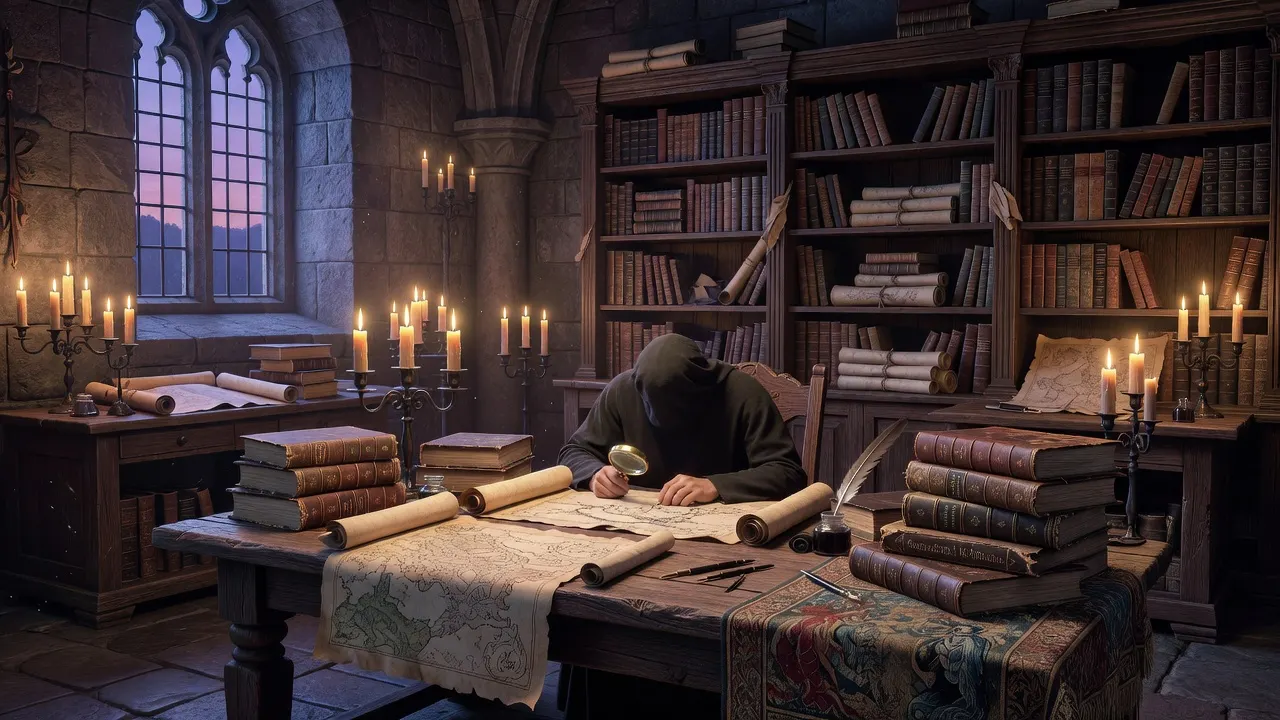
Give the past a job in the present: shape current customs, conflicts, places and choices through earlier events. Build only the history your story or game needs, then reveal it through records, memories, objects and consequences. Leave space for uncertainty, so readers or players can explore the past rather than receive it as a lecture.
Key facts
- History can explain how a world works and connect earlier events to people, places, objects and factions that matter now.
- Influential figures and key moments can shape a convincing fictional history.
- History-building can include timelines, pantheons and ways to make ancient events relevant to present-day adventures.
- Historical texts, myths and records can give characters sources to consult.
Make the past explain the present
A fictional history earns its place when it helps explain how the world works now. Start with a present pressure: a disputed custom, strained alliance, dangerous ruin or choice facing a character. Trace backwards to an event that could have produced it. Then follow the consequences forward, asking who benefited, who lost, and what people remember. This approach connects past events to current people, places, objects and factions rather than leaving them as detached lore.
Choose key moments and influential figures for the effects they leave behind. A ruler’s decision, a migration or a broken pact can alter daily life long after its original actors are gone. Give each event a visible echo: a local rule, an inherited object, a divided community or a story people tell differently. Historical depth comes from those links, not from the length of a chronology.
Let the setting carry evidence. A place where an event happened can make its history tangible, while a record or myth can reveal what people think happened. You do not need to explain every cause at once. A reader can meet an echo first, then discover its source through a clue or a character’s choice.
Choose the right scale and reveal it with purpose
Set the scale by the story or game you are preparing. A campaign-focused game master may need only a limited span of regional history; distant periods can use broader strokes. The aim is not to fill every gap. It is to give the audience enough context to understand a current situation and act within it.
Use a working timeline to check order and cause, but do not mistake the timeline for the story. A custom calendar can help place events visually, while a short list of turning points may be enough for a draft. Keep details that affect the present; set aside fine-grained information that has no bearing on characters, places or decisions.
Reveal the past in forms that fit the scene. A character might find a document, hear a disputed account or recognise a symbol. Flashbacks, historical documents and revelations can uncover hidden truths without stopping the story for a full account. Give the audience hints and questions to follow, and let discoveries change what a character understands or chooses.
What this means for you?
Historical depth is useful when it changes how a reader interprets a scene or how a player approaches a problem. It need not mean a large archive of dates or dynasties. Instead, build a chain: an earlier event leaves a trace; people disagree about that trace; the disagreement affects a present choice. This makes lore available for storytelling rather than a separate lesson.
If you are a game master preparing a ruined settlement, begin with what the group can encounter there: a damaged boundary marker, a local warning or an object with contested ownership. Decide what earlier event could connect those details. Then determine who tells the history, what they want the group to believe, and what evidence might complicate that account. Historical records and myths give characters things to consult, while the place itself can carry the weight of what happened.
For a novel, attach the past to a character’s immediate stakes. A family keeps an object, a community repeats a story, or a revelation unsettles an assumed truth. These details can suggest a larger history without requiring an explanatory pause. A fictional world also need not copy real history exactly: you can draw on historical elements selectively and shape them around your themes.
Use a simple test for each piece of background: does it explain a current pressure, deepen a place or alter a choice? If not, save it for later. You can still keep private notes for consistency, but give the audience only the parts that create meaning, curiosity or a useful decision.
What to do now?
- Choose one present-day pressure in your setting. Write down who feels it, where it appears and what choice it forces. Keep the starting point concrete.
- Invent one earlier turning point that helps explain that pressure. Note who shaped it and who experienced its consequences. Connect those consequences to something the audience can encounter now.
- Make a compact timeline or event list to check sequence and cause. Use broad strokes for distant history, and keep details that matter to the current story or game.
- Choose one way to reveal the past: a record, a myth, a place, a flashback or a character’s discovery. Let it raise a useful question instead of explaining everything.
- Check each detail against the present. Keep what changes a character’s understanding, a player’s options or the meaning of a place. Move unused lore into notes, and return to it only when the story needs it.
Sources
- thelorewiki.com
- rebeccashedd.com/2024/04/12/the-worldbuilders-toolkit-history-lore
- www.anima-roleplay.com/resources/worldbuilding/lore-history-building
- richiebilling.com/worldbuilding/how-to-create-a-history-for-fantasy-world
About this page
Written with AI assistance from the sources listed above, then checked by automated fact, source, repetition and quality checks before publishing.
Facts and links checked on 1 November 2026. Summarises the sources linked above; check the linked source for the latest version.
How we researched this: we compiled this guide from the official and independent sources listed above, and checked the facts on the date shown. Our editorial policy explains how we choose and check sources.