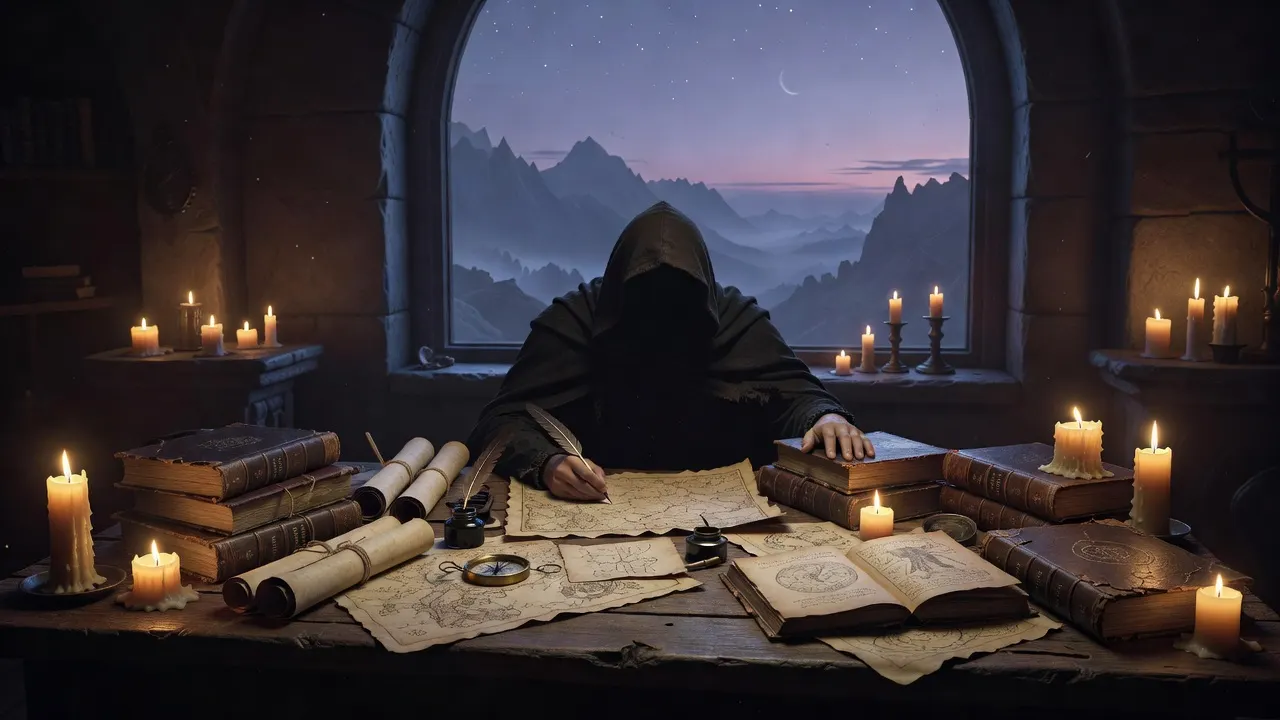
Start with a small, story-ready world rather than an encyclopaedia. Choose a physical setting, give its people a shared history or belief, and decide how one important rule works. Record those choices clearly, then write a short piece of lore that characters might tell. Add detail only when it strengthens a story or character.
Key facts
- Fantasy worldbuilding begins with the physical environment of the story.
- Lore can draw depth from world history, mythology and implied layers.
- A piece of lore can be short rather than long or detailed.
- A lore bible can record a world’s characters, factions, places, events, rules and timeline.
Begin with the place and its people
Give your universe a physical starting point: one landscape, settlement or route that matters to the story. The physical environment forms a foundation for fantasy worldbuilding, while geography, history, cultures and languages can all demand attention. You do not need to build each layer at once. Pick the feature that makes a character’s immediate choices more interesting.
Then connect the setting to human experience. Lore can feel deeper when it draws on recognizable experience and gives it a fresh angle. A custom might govern who shares food, how people mourn, or what they fear in the dark. These are prompts, not required world facts: choose one that affects the scene you want to write.
History and myth can supply another layer. The SandDancer guide points to world history, mythology and implied layers as sources of depth. For your own setting, decide what people believe happened and how that belief shapes their present. You can keep the truth uncertain. A contradiction between what people say and what a character sees can make the lore matter without a long explanation.
Keep your first scope narrow. A large list of geography, history, cultures and languages can feel like it competes with writing the story itself. Choose only the setting details needed to create pressure, wonder or a meaningful decision. Leave the rest open until the story calls for it.
Make lore useful in a scene
Treat lore as something a character might tell, remember or argue about, rather than a block of background information. The Write Practice describes lore as a story characters would tell. That shift gives each detail a speaker and a reason to appear. A tale can reveal what a community values, while a disagreement about the tale can show who holds power.
Write one small piece first. The Write Practice recommends writing a short piece of lore set in a world of your creation, and notes that lore need not be long or detailed. Try a rumour, custom, warning or remembered incident. After drafting, ask what a character gains or risks by repeating it. If the answer is nothing, save the idea for later.
Reveal details selectively. Effective worldbuilding layers lore and reveals only what enhances the story and character development. This means you can know more than the reader sees. Put a clue in a choice, an object or a disagreement, then leave space for the audience to infer the wider history.
What this means for you?
You can build a convincing universe by making a few connected choices, not by filling a catalogue. Start with a place, a belief or custom, and a rule that affects someone. The physical environment can anchor the setting, while history, culture and language are among the many elements worldbuilding may involve. Treat these as options to develop when they serve your story.
If you are a writer planning a first fantasy story, imagine a traveller entering a settlement where people refuse to cross a bridge after sunset. You do not need to explain every cause immediately. Decide what the traveller needs, what locals say about the bridge, and what consequence follows if someone crosses. Those choices create a usable piece of lore: a story people tell, tied to a character’s decision.
Keep a working page for the decisions you have made. Note the setting, the belief, the rule and any unresolved question. A lore bible can serve as a reference for what is true in a world, including its rules and timeline. Your version can stay modest: clarity matters more than length. Separate firm choices from ideas you may change, so a passing possibility does not become a constraint by accident.
When you feel tempted to expand, check whether the new detail changes a scene, a character or a conflict. Lore gains depth through recognizable human experience and a fresh angle, while selective revelation can keep it tied to story and character. If it serves none of these, keep it in a spare-ideas list. You can return when the draft gives it a purpose.
Use whichever working method helps you stay organised. Sketchbooks and real maps can help when creating a fantasy world, and choosing a mix of old and new tools can simplify the process. A notebook, a map or a digital document can all hold your decisions. The tool is there to support the story, not to set its scale.
What to do now?
- Choose one place where a scene could happen. Describe its physical feature and the immediate problem it creates. The environment is a foundation for fantasy worldbuilding.
- Give someone who lives there a belief, custom or piece of history. Connect it to recognizable human experience, then add an imaginative twist.
- Write a short account of that lore in a character’s voice. Keep it brief; lore does not need to be long or detailed.
- Link the account to a choice or conflict. Remove details that do not help the story or character development.
- Record settled choices and open questions in one reference page. Include only categories you need, such as places, characters or rules.
Sources
- www.thebookdesigner.com/fantasy-world-building-approaches
- sanddancer.pub/blogs/ink-shadows-blog/how-to-create-fantasy-lore-that-captivates-readers
- thewritepractice.com/how-to-write-lore
- www.eposyne.com/insights/how-to-write-a-lore-bible
About this page
Written with AI assistance from the sources listed above, then checked by automated fact, source, repetition and quality checks before publishing.
Facts and links checked on 1 November 2026. Summarises the sources linked above; check the linked source for the latest version.
How we researched this: we compiled this guide from the official and independent sources listed above, and checked the facts on the date shown. Our editorial policy explains how we choose and check sources.